

Brand positioning canvas
This canvas helps you build and strengthen a brand that drives customer preference. A brand has two aspects: strategy and identity. Brand identity is how your strategy is expressed visually and verbally, and includes your name, logo, colours, and tone of voice. Strategy must come first. Your value proposition and competitive positioning form its foundation. Without this, you cannot answer the question customers are actually asking: "Why should I choose you over the competition?
Jeff Bezos, Amazon’s founder, described a brand as
“What people say about you when you're not in the room.”
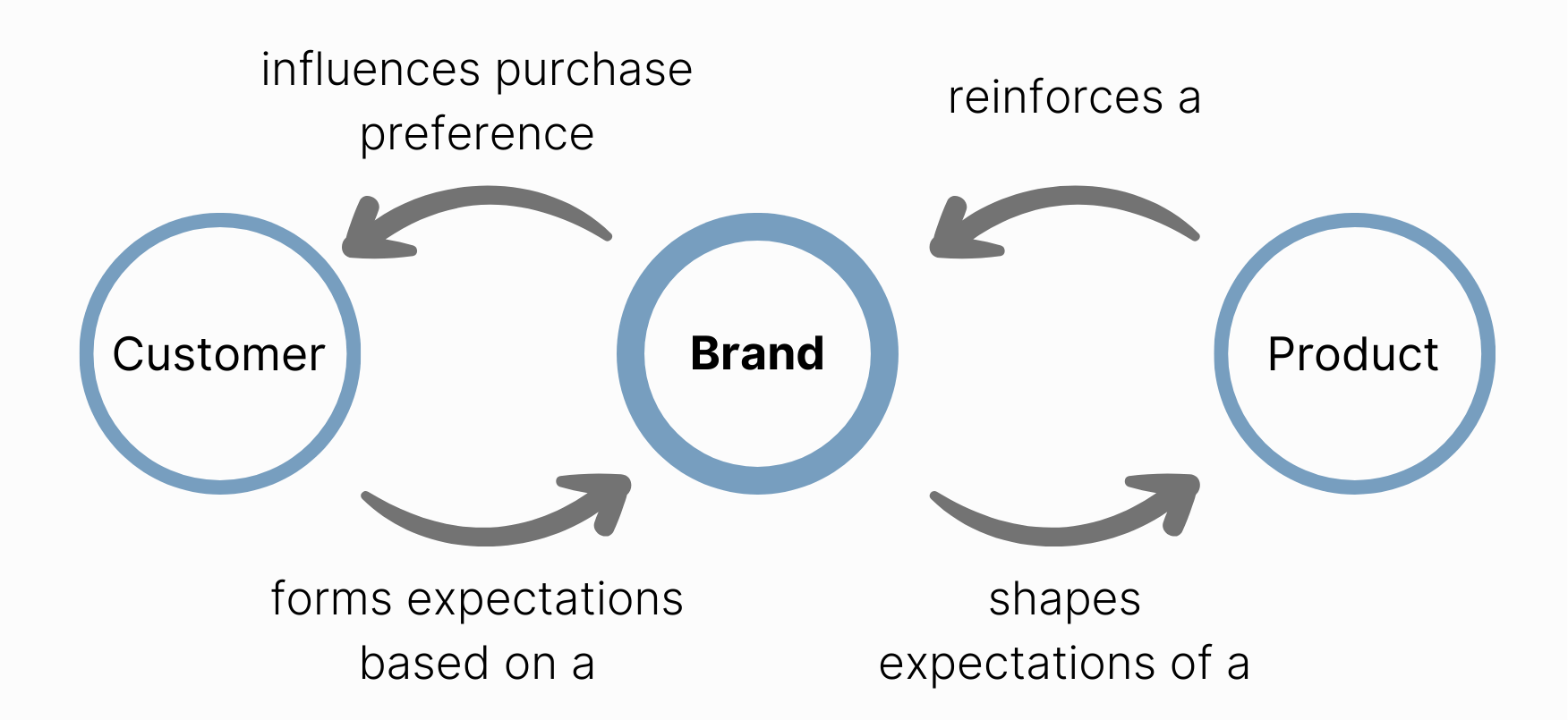
A brand shapes what customers expect before they experience your product. A strong brand and product reinforce each other. The brand influences purchase preferences, and the product experience either validates or undermines it. Each product's value proposition is captured on the New Product Generator Canvas or the Market Positioning Canvas, which forms the foundation of what your brand promises.
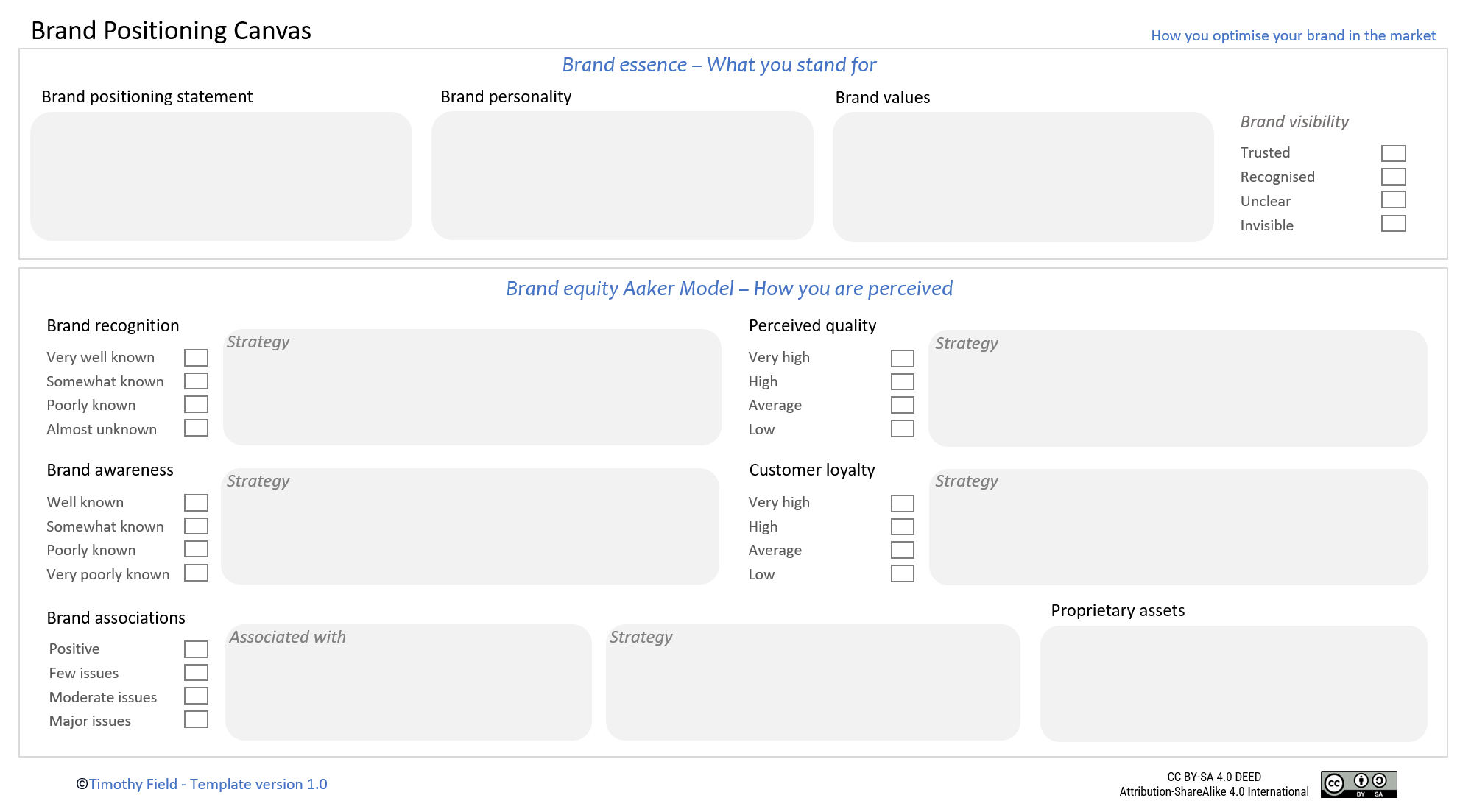
Brand Positioning Canvas
Feel free to recreate the canvas in a tool of your choice. Please attribute the author (Timothy Field), the source of the canvas (this webpage) and add the CreativeCommons BY-SA license
Brand and product relationship in detail
The diagram below explains the impact a brand has on a product. You should regularly review your products for issues and opportunities against these brand aspects:

Using the canvas
Each section contains a box for “strategy“. This should detail your approach. If you are making improvements, you don’t have to work on all of this at once. For example, you want to focus on improving brand awareness. Most sections have a simple maturity scale. This can give you an overview of health, helping you prioritise your actions. This canvas includes David Aaker’s definition of Brand Equity. This is the measure of the perceived value of a brand-name product. Having high brand equity translates into higher revenue. For example, you can charge more even when there is no difference in quality, and you will see higher retention rates. Details on each aspect are provided below:
Brand essence - Containing brand values, personality and your positioning statement.
Brand equity - David Aaker’s model:
Foundations
The foundations of a successful brand are the “C’s”:
Clarity - be clear on what you offer.
Consistency - with your tone of voice, visuals, colours, etc.
Constancy - regularly remind customers that you are there.
The process below shows how you create the brand, and you should use these foundations throughout your work.
Brand Creation Process
There is no single industry standard way of approaching brand creation.
Ideation and pre-launch
1. Starting out: product before brand
When starting out, your priority is your product and achieving product-market fit. The implication is that you should do the minimum brand work necessary to sell effectively. Time and money spent perfecting brand assets before you have paying customers is largely wasted, because you don't yet know enough about who your customers are and what resonates with them.
2. Making foundational decisions
You need to make the most basic of decisions, such as brand colours, at this stage. It is important to do a high-quality job where the decisions are hard to reverse. The hardest to reverse are your name, your market category, and your visual identity. For example, Luma, a consultancy that sells operational efficiency services to professional services firms, chose to position itself as "consulting-led, software-enabled" rather than as a software company. Reversing that category decision later would mean re-educating every prospect they had already spoken to. Getting it wrong early has a compounding cost.
Early traction
3. Testing your brand assumptions
From the outset, your brand is treated as an assumption. In stages 1 and 2, you make necessary decisions without customer evidence. Informed judgment is the best you can do. Stage 3 is where those assumptions are formally tested. A formal testing method is required, with structured criteria for what counts as confirmation or contradiction of each assumption. Without this, it is easy to mistake enthusiasm from a small, unrepresentative group for a validated signal.
The priority is strong negative reactions. These are the assumptions actively harming your ability to sell and must be addressed first. For example, a consultancy with a brand value of "always optimise time to value" may find that this translates into recommending a large upfront spend. The value sounds compelling internally, but the client strongly rejects it. The brand assumption is creating a commercial barrier rather than a differentiator.
The ultimate test is simple: did it sell? Everything else, including message resonance, ICP fit, and perception of your market category, is directional. Revenue is the only conclusive measure.
As assumptions are validated, your brand begins to do real work. A strong brand shapes what customers expect from your product before they have even used it. This relationship is shown in the brand and product diagram above.
Growth
4. Strengthening your brand
As you approach product-market fit, evidenced by repeatable sales, consistent customer language, and low churn, you shift from testing brand assumptions to actively strengthening them. You now have enough signal to make brand decisions with confidence. Your brand begins to shape product decisions rather than follow them, and your customers' perception of you becomes the primary input into that process.