

Brand essence


This section of the canvas is your essence. It defines what your brand stands for and what feelings it evokes. You are looking to build an emotional connection with your customers. This can build trust and provide a competitive advantage. Think of a famous brand like Ferrari and consider how you feel about it. This is not easy to replicate. I could produce high-performance red sports cars, but this does not mean I can compete on an emotional level.
The essence can be defined with:
Brand values - These are your guiding principles that customers should recognise and resonate with.
Brand personality - How you connect with your target audience. Consider Haribo, the maker of sweets, they could be described as playful and fun. Imagine what would happen if they had a personality that was serious and informative. Would they resonate with their customers if they focussed on their ingredients and manufacturing processes? Your personality should match the expectations of your audience.
Brand positioning statement - The positioning statement provides the overall direction for your marketing and communication. The positioning statement describes how you stand out from the competition.

Brand Values
These are your guiding principles that customers should recognise and resonate with. Values are defined by what you believe in and stand for. Whether you are caring for the environment or pushing the limits of science. Just saying you have values is not enough, customers should recognise and trust these.
Customer alignment
There can be different levels of alignment, from none to strong. This will be contextual to your Ideal Customer Profile. Patagonia have selected you could say, “Use business to protect nature”. This is a strong message for a clothing company. You may attract customers to your clothing because of this value. Alternatively, applying this to a doctor’s surgery may be an odd match and not resonate. In fact, Patagonia’s value becomes a differentiator here.

The cost of demonstrating a value
Demonstrating a value can carry a cost. This must be outweighed by the benefit. Consider my environmentally friendly clothing company, which now needs to use more expensive, environmentally friendly dyes. I cannot simply ignore these impacts. If I start to cut corners, I may invite bad press and lose customers. You are asking the customer to pay more for your product because of your value. This may shift your Ideal Customer Profile, although you could attract a large section of the market with this differentiator, a section may not be able to pay the premium.
The worthlessness of hygiene factors
A hygiene factor is a value that your customer expects and that any credible competitor could claim. For example, saying “We deliver high quality” is typically just a given. There is a really big anti-pattern here that makes these less obvious. Translating hygiene factors into impressive-sounding sentences, then thinking these have more value, e.g. “Quality always comes first” or “Quality is our priority”. These sound good but are still next to worthless. A good test to find these asks:
Does a customer simply expect this?
Will a customer choose us because of this?
These powerful questions will help you consider the context you are in. “Quality is our priority” may actually work if your competitors are consistently releasing poor-quality products.
Types of values
There are no industry standard definitions for types of value. You can use these below to improve your values:
Commercial - Values that directly translate into measurable financial outcomes for the customer. The customer doesn’t connect emotionally with these but does see them as a benefit. Revenue increase, cost reduction, and risk reduction with a financial consequence. Primarily outward-facing. For example, in a SaaS product, “We connect everything to business value” or “Always seeking the levers to help you lower costs”.
Emotional — These align directly with your customers’ values. Let’s use Patagonia as an example: "Cause no unnecessary harm" and "protect nature." Customers feel aligned with these. They may not directly increase Patagonia’s profitability, but they attract a specific buyer who pays a premium. If that premium outweighs the cost, this is a double win: you appeal to your customers’ values and make more money.
Operational - Values that differentiate your product or service. "We measure time-to-value in days, not months", could be a value directly targeted at your hands-off competitors. "Ease of use built into everything", which resonates with the majority of customers who aren’t experts and are fed up with your competitors’ product complexity.
Internal, e.g. talent and cultural - These values are used to attract and keep the people who work for you. They may not align strongly with external customers, but if made public, they should not do damage. For example, “Get in and get out fast” for a consultancy may be useful for guiding consulting engagements, but a client could view these as “Make money as fast as possible”.
Brand values process
The following process will help you decide on your brand values. The process is designed to guide you. Ultimately, it is up to you what you prioritise.
Each person should have read this guide and have it in front of them for reference. At a minimum, cover hygiene factors, types of values and the prioritisation grid.
Present your organisation’s vision and mission statements to align on why you exist.
Create your brand values - what do you want to be known for?
Each person should draft sentences that reflect why you are different. Then get them to discard any that are too close to obvious hygiene factors without discussion. It is OK if someone has produced nothing of value at this stage. Discussions about values that won’t work will create noise and lengthen the process.
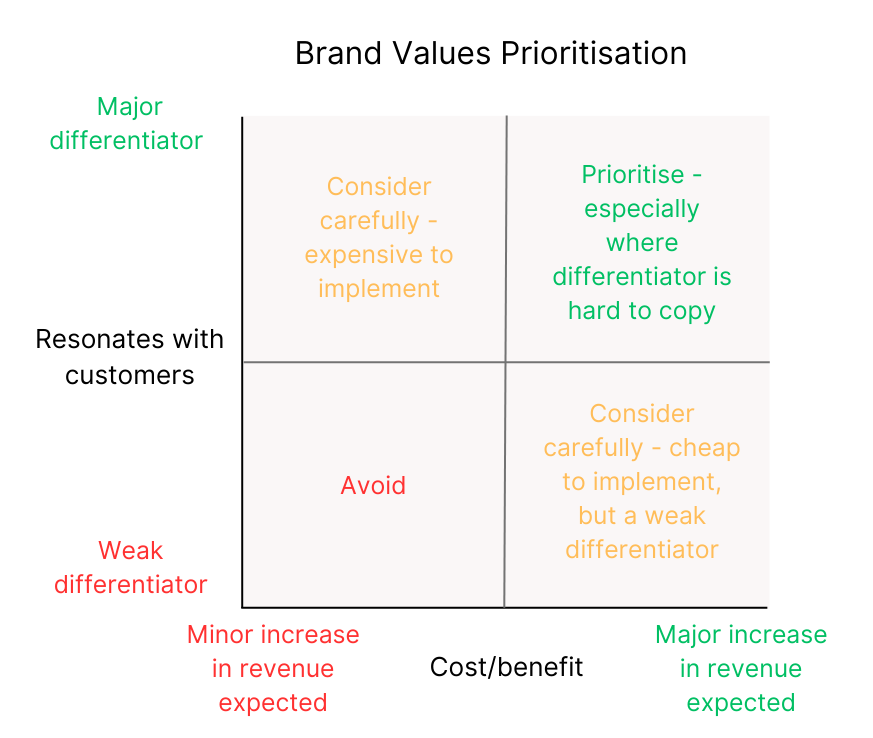
Prioritise the sentences on the grid, considering how they reflect who you are.
Map a maximum of 10 sentences onto the prioritisation grid:
Make a decision:
Aim for around 3 or 4. Too many and you will lose the clarity of your messaging, too few and you may be missing a competitive advantage.
Test with your target customer group:
You may talk with a current trusted customer to gain insights into their view, or alternatively, build the messaging into your sales material and see how it resonates. You are looking to understand:
“Which of these matters most to you when choosing a brand?”.
“Would any of these affect the likelihood of you buying a product?” (This can be negative and positive).
Finalise your brand values, communicate and create a change plan in your organisation to support them. For example, product offering, marketing materials, and internal processes.
Brand visibility
Values should underpin everything you do and result in consistent behaviour. The following maturity scale is on the canvas and considers the perception of most customers. The questionnaire provided offers a way to assess this.
Trusted - Your target customers strongly believe that you represent your values, and it is a key reason why they support you.
Recognised - Your target customers strongly believe that you represent your values.
Unclear - Customers aren’t certain about your values but think they know them.
Invisible - Customers don’t know what your values are.
Customer questionnaire
What positive or negative words best capture what we stand for?
Highlight positive and negative, then order these by the customer’s level of certainty. For example, positive words - environmentally friendly, fun, high quality.
How do you perceive our values?
Trusted - This value is a big reason I support this brand, and I believe they truly live it.
Recognised - I’ve noticed this value consistently across the brand.
Unclear - I’ve seen some evidence of this value, but it’s not clear.
Invisible - I haven’t noticed this value at all.
After you have surveyed enough customers, update the canvas section with your overall results. Score this where most customers
Gathering more in-depth insights.
For each value, for example, “environmentally friendly”, ask, “How clearly do you see this value in action?”
Trusted - This value is a big reason I support this brand, and I believe they truly live it.
Recognised - I’ve noticed this value consistently across the brand.
Unclear - I’ve seen some evidence of this value, but it’s not clear.
Invisible - I haven’t noticed this value at all.
What else would you like us to know about our brand values? (open question)
After the survey activity is complete, you may wish to create a plan to improve.
Brand personality
A brand personality treats a brand like a person with a set of human traits. There are many benefits to this:
Brand loyalty - It is designed to build an emotional connection with a target customer and build greater brand loyalty.
Differentiator - This is especially useful in a crowded market.
Focus - It can help you better define your target customer group. For example, Red Bull focuses on excitement, which won’t appeal to everyone.
Memorability - Personality, especially applied to visuals, tone and characters, can help a brand stand out. Consider Colonel Sanders and the strength of the KFC brand because of him.
A benefits example
Old Spice was rebranded in a campaign featuring Isaiah Mustafa.
125% increase in sales in the first month after the launch of the campaign (Procter & Gamble internal data).
107% year on year sales increase of Old Spice Body Wash within six months.
This was especially effective as the associations people had with the brand were very negative.
Links to brand values
After setting your brand values, consider how a brand personality would best complement them. These should be in sync. For example, having a brand value of “expert” and applying a personality of “silly” wouldn’t make any sense.
Brand Personality Framework
This framework was developed by Stanford marketing and brand expert Jennifer L. Aaker. It considers five distinct characteristics of personality.

These personalities can be further described:
Sincere - This is about genuinely caring about customers. It can be further described as down-to-earth, honest, wholesome and caring.
Excitement - This is about the thrill a customer feels. It can be further described as daring, imaginative and spirited.
Reliable - This is about a customer trusting in your expertise as well as high-quality products. It can be further described as intelligent, successful and knowledgeable.
Sophisticated - This is about a customer wanting luxury and style. It can be described as elegant, charming and premium.
Rugged - This is about a customer wanting strength and longevity. It can be further described as resilient, durable and tough.
Creating a brand personality
This is best done with a group of people:
Start with your brand values. You are looking to compliment these. Inform people that the personality you chose should be a representation of your values.
Review the brand personality categories. Go through the descriptions above so everyone understands them. See if you align strongly with any of these. You can go outside of these categories, but you may not need to.
Brainstorm 3 to 5 words each that best describe your personality.
Bring together everyone’s words and prioritise these, taking into account your brand values.
Apply the personality to your:
Visual identity - For example, your colour palette, fonts and photography style.
Assets - Consider anything that impacts the customer’s experience. This can include digital assets such as websites, social media and emails or physical assets like packaging and store design.
Characters - Create a character or use a real person to represent your brand’s personality.
Tone of voice - Ensure all communication and content is written with this personality in mind.
Brand positioning statement
The brand positioning statement provides the overall direction for your marketing and communication. It is an internal summary that is not shared with customers and can, therefore, be more comprehensive. The positioning statement explains what you offer and how you stand out from the competition. It can also include how you are perceived. The organisational mission statement differs here as it is used internally to describe why the organisation exists.
There are two levels of positioning statements:
Brand positioning - The overall value you offer, including any differentiators. If you have multiple products, this will encompass them.
Product positioning - The same but at a product level.
The positioning statement in this canvas is to be used at the brand level. You are setting expectations for your customers, and it is important that you meet them. For example, if you claim to have the most efficient service, make sure you do.
Brand positioning strategies
Here are many differentiation strategies you can consider using. These should apply to every product. For example, when you decide your brand is to be known for its ease of use. Here are some examples:
Customer Service - Offering great customer service, such as being more friendly. This should be considered where products are complex. It can also be helpful in a mature market where there are few functional differentiators.
Ease of Use / Convenience - Taking less of a customer’s time and making it easier for them to get something done. Consider Apple’s products and their usability.
Low price - Pricing is a very large subject that is not covered here. In this positioning strategy, you are looking to provide the cheapest option. Consider low-cost airlines with their basic service.
High quality - Emphasising the quality of your products as a differentiator. You can aim to charge more in this instance.
Functional - Emphasising the strong functional differentiators of your products. Strongly consider using this if you have a new type of product.
Values - Emphasising aspects like environmental credentials or charitable contributions
Here are some examples:
Apple has an Ease of Use / Convenience-based strategy: “To bring the best user experience to its customers through its innovative hardware, software, and services. We believe that we are on the face of the earth to make great products, and that’s not changing.”
Nike has a Values-based strategy - “At Nike, we’re committed to creating a better, more sustainable future for our people, planet, and communities through the power of sport.”
Airhouse has an Ease of Use / Convenience-based strategy - “Airhouse helps direct-to-consumer companies get orders from factory to front door. Sync your shop, send inventory, and you’re all set.”
Creating a statement
It can help a great deal to study other organisation’s brand positioning statements. Large organisations, such as Amazon, will have this at a very high level. Where you aren’t very well known, your statement should be more detailed. Below are some considerations for your statement:
Who is it for?
What are the core benefits/differentiators?
What category of products do you offer?
What outcomes do you provide?
What reason should customers believe you?
Here is a made-up example:
SanctiTea is a wellness brand focused on creating healthy, calming drinks to support people who want a mindful, environmentally friendly lifestyle.