

B2B - Buyer persona canvas
In business-to-business (B2B) selling, you may find multiple people involved in the buying decision. These people will have specific criteria for selecting your product. If you only appeal to a few of them, you may find the sale falls through. By modelling these customers, you can improve your messaging and content to better target their individual needs. You are looking to build trust with your customers by creating a strong personal connection. These personas can be used in marketing and sales. The personas are typically based on roles. However, you may wish to split this further. For example, the needs of a start-up CEO may differ greatly from those of a multinational.
The key benefits are:
Better relationships from customer’s needs being met, how they want them to be met
Reduced cost by spending less effort on inefficient marketing and sales activities
Increased win rates in sales
Uncover buyer’s unmet needs
As you take part in a sale, you will move away from personas and begin to understand the individuals.
Refine your personas as you learn more, for example, when you see the way most people want to interact with you. Does the typical Chief Financial Officer want a brief slide on costs and ROI? Does the lead architect usually want a technical document on a typical deployment? You can do this post-sales by gathering feedback on what went well and what didn’t. Look for patterns, for example, are most CFO’s telling you there was too much information given to them. The single most important anti-pattern for buyer personas is building them from job titles and assumptions instead of real sales data.
When you have completed the buyer personas, refine your marketing and sales approach to meet their needs.
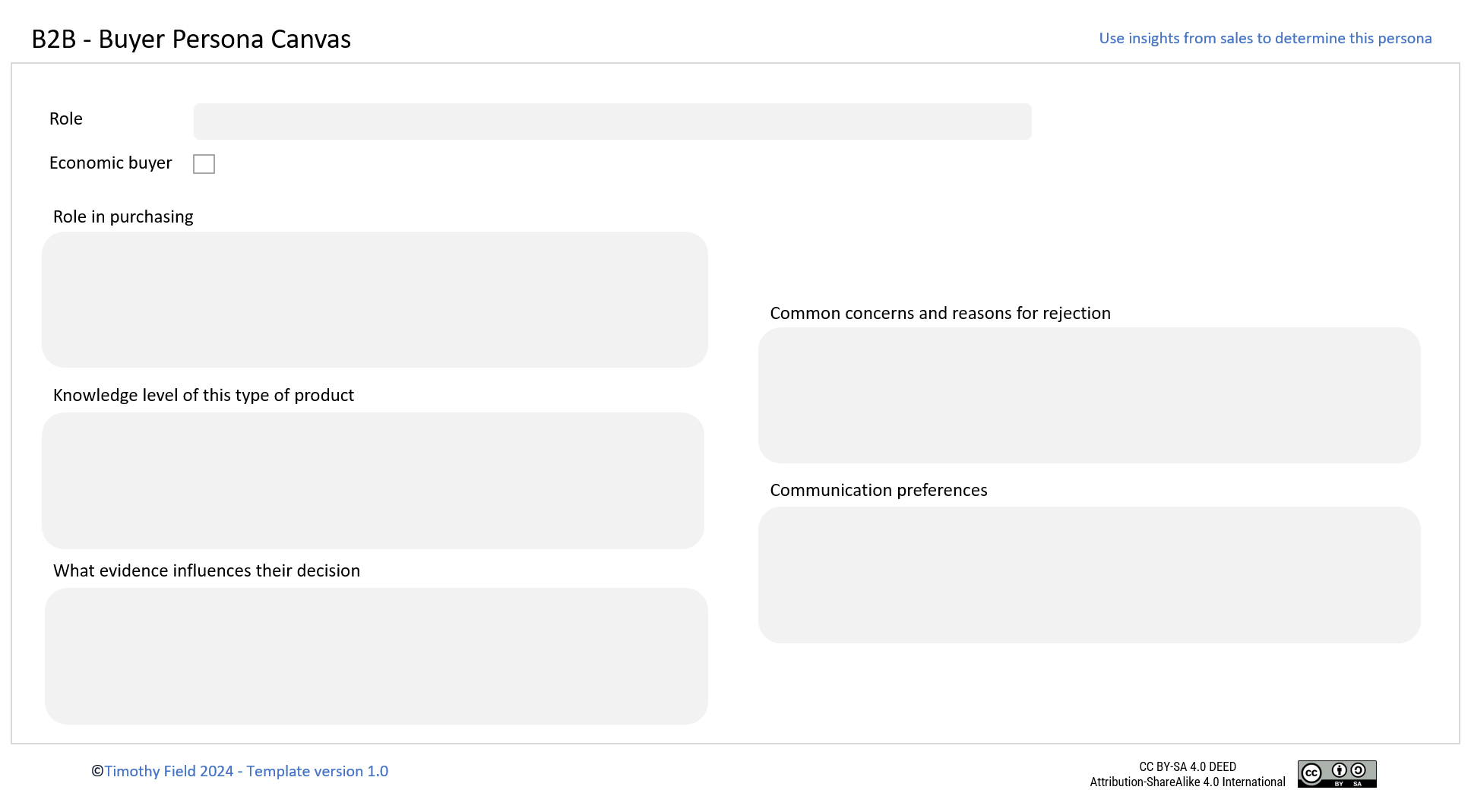
Feel free to recreate the canvas in a tool of your choice. Please attribute the author (Timothy Field), the source of the canvas (this webpage) and add the CreativeCommons BY-SA license
Links to other B2B canvases
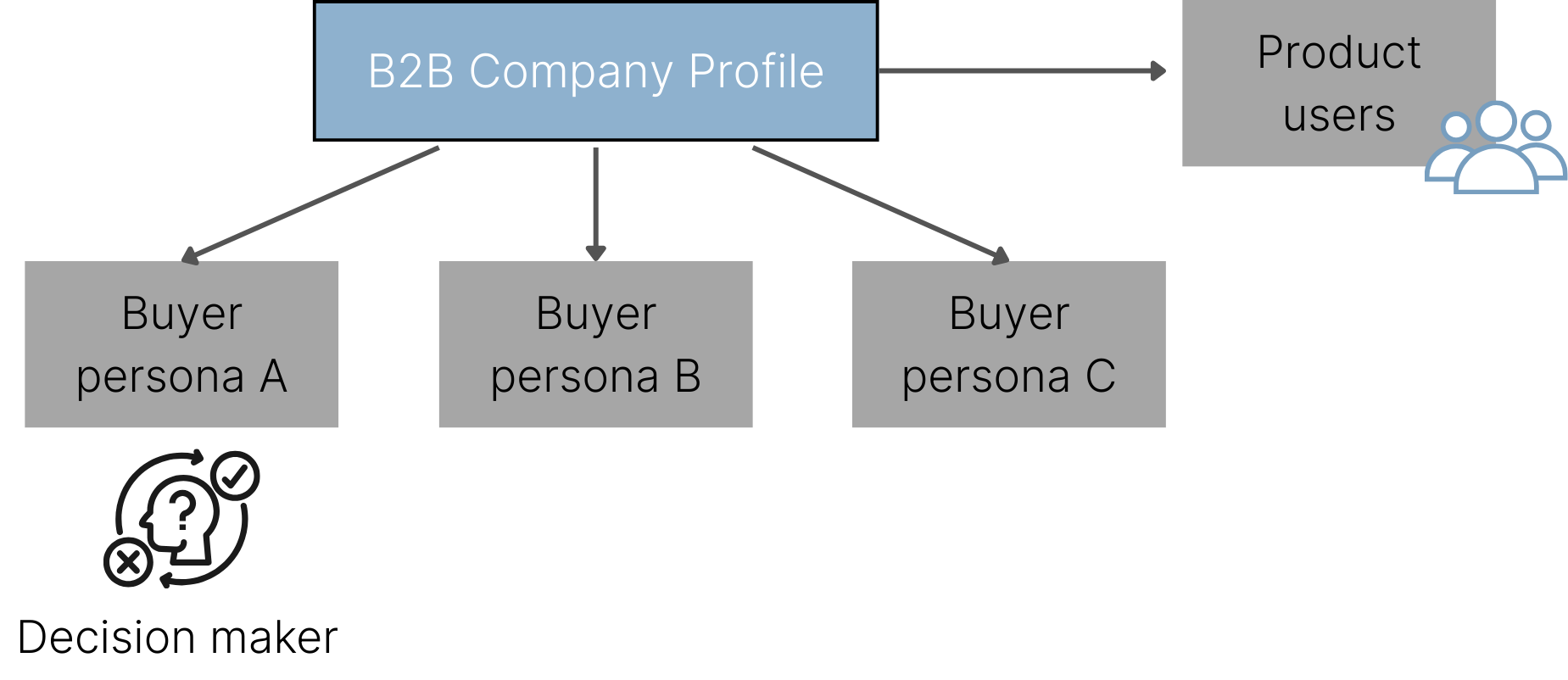
B2B Company Profile - The target company type you are selling to. You may have multiple buyers within this, each with its own buyer persona canvas.
B2B User Persona - The types of users of the product you are selling.
Role
The person’s role is particularly important. A CFO (Chief Financial Officer) is likely to be involved in the later stages and interested in the timeframe to achieve benefits, whereas a CPO (Chief Product Officer) will be more interested in how the solution will benefit the organisation.
Role may include a number of names for similar things, for example, if targeting a development team, you may have:
Developer
Analyst programmer
Principal developer
etc.
Single versus multiple personas
Be aware that the same functional role can have different titles across companies. For example, if targeting a development team, you may encounter Developer, Analyst Programmer, Principal Developer, and so on. Group these under a single persona rather than creating separate personas for each title. What matters is whether their buying behaviour and concerns differ, not whether their titles differ.
Also consider that the same role title can behave very differently depending on the company type. A CTO at a 20-person startup is often both the decision-maker and the user. A CTO at a 5,000-person enterprise may never see your product. If this is significant, create separate buyer personas tied to the relevant Company Profile rather than trying to make one persona cover both.
Economic buyer
An economic buyer is the person who can make the final decision on the deal. This isn’t necessarily the budget holder. These are the people who have access to funds, and how they are used. They may not necessarily own them.
Consider a situation in which a senior architect has a strong relationship with the CEO and wants to buy a tool. The architect will be the economic buyer, as they can convince the CEO to give them the funding. The CEO may not even be heavily involved in the process.
Here are some clues to identifying the economic buyer:
They will be responsible for the ROI of the purchase.
Will be concerned about the success of the implementation.
Will be reporting progress and ROI to senior stakeholders.
Are most likely to sign off a contract.
Avoid the following mistakes:
Targeting the CEO for everything.
Finding out who the budget holder is and selling to them.
Irritating the economic buyer by not paying them enough attention.
Tailor your offering to the economic buyer:
Identify what pain points they have.
Ask them about the concerns they have about switching to your solution.
Ensure they have a high-level rollout plan they are happy with.
Show them how you will achieve the expected ROI.
Knowledge level of this type of product
This will give you insights into the level at which you should explain your offering. Giving highly detailed technical talks to beginners is a sure fire way to reduce their interest.
Are they domain specialists or beginners?
How much will they know about your product?
What does this mean for your approach? A beginner needs to understand the problem before you present the solution. An expert will disengage if you over-explain basics. Pitch at the wrong level and you'll either confuse them or bore them. Both of these can kill the deal.
Role in purchasing
The economic buyer is the key role that is responsible for the purchase decision and is typically responsible for the success of the product after this. Outside of this person, there can be many other people who have a significant impact on the purchase decision:
Trusted advisors - They have no budget but may be considered the experts in the organisation. Sometimes these are the people who will use the tool day-to-day.
Champion - The person who actively advocates for your product internally. They sell on your behalf when you're not in the room. This is distinct from a trusted advisor (who is consulted but passive) and an economic buyer (who decides). If you don't have a champion, deals can stall.
Gatekeeper - Procurement, legal, IT security, compliance. They don't advocate for your product but can block or delay the deal. Particularly relevant for companies with high procurement formality (as identified in your Company Profile's Optimised Sales Approach). Ignoring them is a common reason deals fall through at the last stage.
Influencer — Not directly involved in the purchase decision but could affect the outcome, or could be valuable for future opportunities.
Can affect the current deal:
A senior leader whose opinion carries weight. If they hear about your product negatively, they can derail a deal without ever being in a meeting.
A team lead whose people will use the product daily. If they feel excluded from the process, they can resist adoption after the deal is signed.
Valuable for the future:
A department head who could adopt your product later. Engaging them early builds a relationship for upsell.
A contact in a different division who gives you visibility across the organisation.
In large organisations, early networking can open doors that don't exist yet. Don't wait until you need something from them.
What evidence influences their decision
The factors that influence their decision to recommend you or purchase.
Proof your product works
Direct experience of the product in action. For example:
Product demonstrations.
Proof of concept or pilot.
Free trial or sandbox access.
Internal technical assessment.
Hands-on workshop.
Evidence of benefits
Third-party or external validation that the outcomes are real. For example:
Reference calls with similar companies.
Case studies and published evidence.
Peer or analyst recommendations.
ROI models with verifiable assumptions.
Industry benchmarks or comparison data.
Common concerns and reasons for rejection
The recurring reasons this role pushes back or blocks a deal. These should come from real sales experience — not assumptions. Look at deals you've lost and identify patterns specific to this role. For example:
A CTO consistently raises concerns about integration complexity.
A CFO repeatedly challenges the ROI evidence.
A procurement lead flags your security certifications as insufficient.
Even if you've addressed these in your sales materials, don't assume the message has landed. These objections will keep surfacing. Your sales team needs prepared responses for each one and should actively raise them before the buyer does. Letting an objection sit unaddressed because you think your materials already cover it is a common reason deals quietly die.
If you're hearing the same objection frequently, it's either a genuine product gap, a messaging failure, or both. Track which it is and act accordingly, update the product, fix the messaging, or prepare a direct response.
Communication preferences
The practical mechanics of communicating with this role. This is not about what content they need — that's covered in "What influences their decision." This is about format, frequency and timing:
Format: Do they prefer email, calls, face-to-face, or a slide deck they can read in their own time?
Frequency: Do they want regular updates or only to be contacted at key milestones?
Timing: Do they get involved early in the process or only at the end to sign off?