

Business Model Canvas
The Business Model Canvas was developed by Alexander Osterwalder and Yves Pigneur to give a bird’s-eye view of an organisation or product. This strategy tool gives a high-level summary and should be augmented with detailed documentation. It helps you evaluate new business models, improve your strategy and create alignment.
The canvas offers a strategic advantage by considering various factors that can enhance your chances of success and lower costs.
The canvas can be used for:
New products - Structure and optimise a new product.
New chargeable features - This is where you have an existing product and add a feature that you will charge for. For example, you have a reports engine and add an AI reports generator to it. The canvas is optional here, but strongly recommended. It will be most helpful when your feature causes you to diverge away from your current business model. For example, you have new key partners, activities and resources.
Generating strategy options - Map the current state and identify issues and opportunities.
It is also helpful for alignment:
Explaining your business model to investors or partners.
Onboarding new employees.
The canvas can be created at multiple levels. In the example below, you could have up to three canvases:

Using the Business Model Canvas with the Commercial Product Framework
If you are using the BMC to drive your analysis but wish to take advantage of some or all of the CPF toolset, you will find the mappings below. The canvases in the Commercial Product Framework (CPF) provide a great deal of depth to each section. In this case, you would complete the CPF canvases, then transfer the top-level detail to the BMC. The New Product Generator Canvas is used for new products, and the Market Positioning Canvas is used for existing ones. You will produce only one of these. The same applies to the B2C and B2B canvases, e.g. only produce the B2C canvas if you are selling directly to customers.
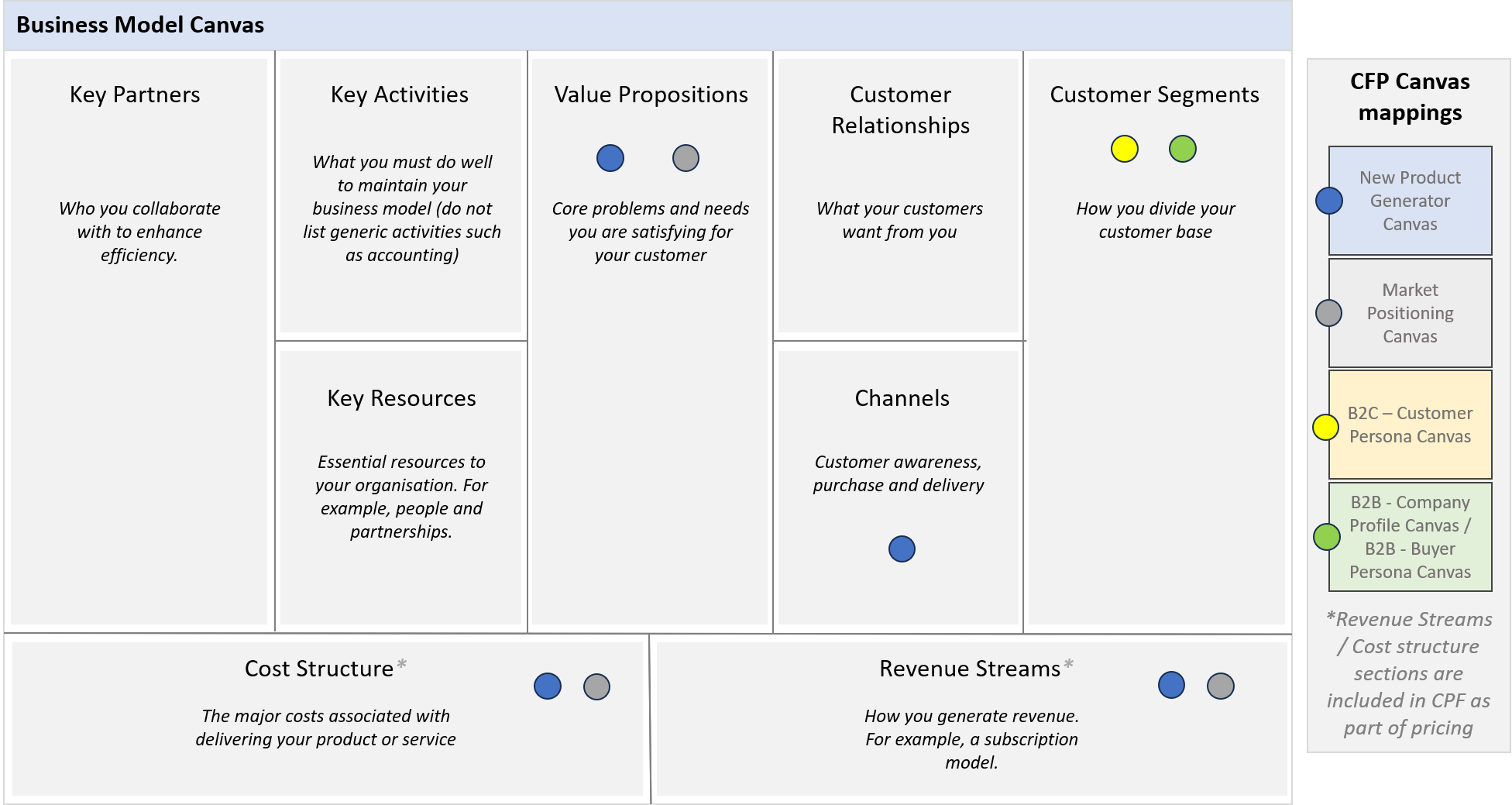
The original Business Model Canvas is available on Strategyzer.com and is Copyright Strategyzer AG. The original Business Model Canvas is licensed under the Creative Commons Attribution-ShareAlike 3.0 Unported License. To view a copy of this license, visit http://creativecommons.org/licenses/by-sa/3.0/
Strategic direction - Opportunity identification with existing products
These instructions explain how to identify strategic opportunities on the BMC. The Commercial Product Framework (CPF) includes a strategy layer. After you have created the BMC for your existing product, you should follow the Strategic Direction stage to help you create your strategy. This begins with prioritising one or more of the five potential strategies below. Any mandatory work identified should be completed regardless of direction. With a strategic priority in place, you can now apply it to the canvas. For example, with the “Reduce costs” strategy selected, you would ask, “How do I reduce costs by leveraging partnerships?”. When selecting “Increase market share”, the Resource Based View (RBV) technique can be used for identifying competitive advantages that you may already have but are not utilising.

| Business Model Canvas | |
|---|---|
| Mandatory Work | Where your business model is impacted by new legal and regulatory requirements. For example, a new European quality standard. Only map to this when it is the primary work purpose. For example, if you pivoted to a customer segment in another country, this may require new mandatory work but would be mapped under New Markets/Products. |
| Reduce Costs | Start with identifying opportunities in your Cost Structure, then look across the canvas. For example, you look at Key Partners and decide to leverage a new partner to reduce the cost of selling your product. |
| Reduce Sales Loss & Churn | Dependent on why you are seeing sales loss, high churn rates or experiencing major churn risk. For example, where a Key Activity of data migration is impacting customer satisfaction and causing high churn rates. |
| Increase Market Share |
Value proposition - Create new differentiators. Channels - Optimise and diversify channels to reach more customers. Customer relationships - Create deeper loyalty and engagement with customers. Key partnerships - Strategic alliances that can enhance your value proposition. Revenue streams - Offer new pricing models, subscription services or different ways for customers to pay to expand your reach. |
| New Markets/Products | Create or remodel the canvas when targeting a new market or creating a new product. For example, pivot your customer segment to target another country. |
Creating Strategy Items
Strategy Items are lightweight artefacts that capture strategy options that can be prioritised. They are not required for new products. To better understand these and how to create them, see this page. An example of one is shown here:

Canvas sections
The following instructions will help you create the canvas. It can be tempting to add a great deal of detail, but this will make it hard to understand. The canvas should be high-level and succinct. You can use supplementary documentation to augment the canvas.
Value Proposition
Without a good value proposition that resonates with customers, your whole business model is pointless.
New Product Generator Canvas - Maps to Value Propositions and Channels. Start with this canvas when you are creating a new product.
Market Positioning Canvas - Start with this canvas when you are working with an existing product.
Resource Based View (RBV)
This technique originated from Jay Barney's 1991 article "Firm Resources and Sustained Competitive Advantage". Within your business model, you may have internal aspects that can give you a competitive advantage.
In David Aaker’s brand equity model, these are seen as valuable resources and capabilities that give a brand or product a strong competitive advantage. They can provide credibility and establish trust. For example, owning a patent that provides strong evidence of expertise. They include:
Intellectual Property (IP) - This includes aspects like trademarks, copyrighted material and patents.
Digital assets - This includes aspects like unique content, domain names and proprietary software.
Relationships - This includes aspects like supplier and distributor relationships that cannot be copied.
Brand elements - This includes aspects like colour palettes, characters and jingles.
Proprietary processes - For example, you have optimised processes for delivering physical goods or providing personalised customer support.
You should identify these assets and store them centrally. You can then review them to ensure they are properly protected and have no unauthorised usage.
Determining resources
These are determined using the VRIN criteria:
Valuable - Resource that helps efficiency, effectiveness or customer satisfaction.
Rare - The resource must be rare within the industry.
Inimitable - Competitors cannot easily replicate.
Non-substitutable - Cannot be replaced by other solutions that provide similar benefits.
Process
Identify resources that make the organisation unique.
Evaluate these against the VRIN criteria. They must meet all of them.
Develop a strategy to leverage these.
Invest in these aspects to maintain a competitive advantage.
Links to the Business Model Canvas
You can use the BMC to look for these advantages. For example:
Key activities - You are a world-renowned expert in creating business strategy.
Key partners - You own a large share of a distribution company, resulting in lower shipping costs.
| BMC aspect | Potential advantages | Value Proposition | Ensure that your core value offering is based on VRIN-based resources or capabilities. |
|---|---|
| Key Resources | Highlight resources inlcuding human, physical, intellectual or financial that competitors can’t easily match. |
| Key Activities | Focus on processes or innovations that drive performance and are difficult to copy. |
| Key Partners | Use partnerships that offer unique value or reduce costs in ways others can't easily imitate. |
| Customer Segments | Target groups where you have unique access, insights or a better strategic fit. |
| Customer Relationships | Leverage relationships where you have trust and loyalty. |
| Channels | Use channels that are exclusive, efficient, and hard to replicate. |
| Cost Structure | Identify where you have major cost advantages. |
| Revenue Streams | Use monetisation models that others can’t easily copy. |
Monetising assets
Licensing - For example, where you have a patent and can charge another organisation to use it. Ensure this aligns with your brand to protect your integrity.
Merchandising - For example, using logos to create branded t-shirts.
Strategic partnership opportunities. Here are some examples:
Technology
Enhancement - This is where you enhance a partner’s capabilities. For example, you own a security camera patent and work with a car manufacturer to improve their vehicle security.
Joint development - This is where you combine your technology or operating methods to create new capabilities. For example, you own a moisturiser patent and partner with a beauty company to develop a new product.
Process
Efficiency - Where your unique processes can provide an advantage to a partner. For example, you have optimised product ordering and can reduce their costs considerably.
Customer experience - Where your unique processes can provide your partner’s customers with a much better experience. For example, you have created a room booking system that customers can use themselves. Your university partners want to use this for external speakers to plan their own events.
Key Partners, Activities and Resources
Key Partners
These are the partners that are essential to your business model. For example, in a software training business, partnerships may exist with the software companies. Non-essential partnerships should not be listed. For example, just because you use some accounting or HR software, this does not mean your business model would fail without them. There are several types of partnerships that you can leverage for strategic advantage:
Joint ventures - Where partners develop a new product together.
Strategic alliance - A partnership between non-competitors.
Coopetition - Where there is a strategic partnership between competitors.
Buyer-supplier relationships - To provide a reliable supply of products or services to customers.
Licensing partnerships - Where an organisation allows another to use its technology, brand, product or intellectual property for a fee.
Franchise partnerships - Where the franchisor licenses its business model, operations and brand to others.
Technology/Platform partnerships - Where an organisation builds on or integrates with another organisation's platform.
Distribution/Channel Partnership - Where an organisation helps you reach customers more effectively. This includes resellers and digital marketplaces.
Outsourcing partnerships - Where an organisation outsources key operational activities. For example, manufacturing and IT support.
There can be many growth and cost-reduction opportunities associated with partnerships. Use the list above to look for these.
Key Activities
These are the key activities that the organisation must do to maintain its business model. Don’t list generic activities like HR. This may include how an organisation operates its Channels, maintains Customer Relationships, and earns Revenue. For example, if you are a taxi hire business, Key Activities will be to hire good drivers and get to customers quickly. Here are some other made up examples:
Creating the highest-quality hardware devices.
Creating the best user experience by combining hardware and software into a seamless experience.
McKinsey Consulting:
Conducting high-level industry and competitor research.
Building and deploying high-impact proprietary consulting frameworks.
Attracting the highest-skilled talent.
Maintaining strong relationships with c-suite executives in large organisations.
Key Resources
These are the essential assets that support your product. They can include:
Human resources - The people essential to delivering your product.
Physical resources - Used in production or service delivery.
Intellectual resources - Including patents and copyrights.
Financial resources - Where the capital comes from to support growth, innovation or operations.
For example, McKinsey Consulting:
A globally distributed talent pool of high-quality people.
Proprietary consulting frameworks that can provide a competitive advantage to clients.
Publicly available material that demonstrates experience, domain knowledge and proof of outcomes.
Note that the consulting frameworks are included in both key activities and key resources McKinsey examples. This is because both a strategically critical. Where this is not the case, avoid unnecessary repetition.
Customer Relationships
This is the relationship the customer wants with you. For example, when selling Rolls Royce cars, you would expect a highly personalised face-to-face experience.
Cost considerations
There will be a balance between costs and expectations. For example, customers may want a face-to-face experience with Microsoft, but the cost of support may be too high for them to achieve this. Premium support offerings can be made available to high-value customers or those who are willing to pay extra.
Channels
These are the channels used for customer awareness (where they find out about you), purchase and delivery. Once we have identified our customers, we must decide how to interact with them. Below are some considerations.
Awareness
How do they find out about the product?
Online marketing - For example, social media, working with influencers and websites.
Advertising - For example, Television, radio and Google Ads.
Public relations - For example, media coverage and industry events.
Partnerships - Working with complementary organisations.
Referral programs - For example, affiliate marketing and cash back for referring friends.
Comprehensive advice is available on this page.
Purchase
How do they buy your product? For example:
Through your website or app — The customer purchases directly from you online.
Direct sales — A sales team engages with the customer to close the deal.
Partner or reseller — A third party sells your product on your behalf.
Marketplace — A third-party platform such as Amazon, App Store or an industry-specific marketplace.
Physical location — For example, a retail store or trade show.
Delivery
Digital products — How does the ICP receive the product, and who sets it up? Examples:
Self-service — The customer signs up and configures it themselves.
We set it up — Our team handles onboarding, configuration or data migration.
Partner sets it up — Sold or delivered by a partner who handles the rollout.
Physical products — How do you deliver the product to them? Examples:
Shipping.
We deliver and install.
Pick-up.
Customer Segments
It is vital to identify your target customer before filling in the relationships and channels sections. These canvases help you to segment your target customer group to maximise success:
B2C - Customer Persona Canvas - This helps you define the customer group to service and target.
B2B - Company Profile Canvas - This helps you define organisations to target in a business-to-business environment.
B2B - Buyer Persona Canvas - This helps you understand the needs of the different people involved in the buying process in a business-to-business environment.
New Markets/Products - The “new markets” strategy means selling an existing product to a new customer group. For example, you sell in the UK and now wish to expand to France. When creating Strategy Items, consider recreating these in full where your new segment differs significantly.
Cost Structure and Revenue Streams
The Commercial Product Framework (CPF) considers costs within the pricing sections of the New Product Generator Canvas and, for existing products, the Market Positioning Canvas. This ensures the price you set is not only competitive but also profitable.
In the BMC section, it can be helpful to augment this with:
Making specific areas of high cost visible.
Considering the current cost per unit, e.g. £5 cost per month per user.
Looking for opportunities to reduce costs via economies, e.g., economies of scope, where similar products can share resources, lowering the costs.
Cost structure
Cost analysis can be applied to your own business model to improve efficiency. In addition, you can analyse a competitor’s cost structure to evaluate it for competitive advantage. For example, they may be using a partnership to lower distribution costs.
These are high-level costs. When filling in the canvas, avoid listing too many items. Instead, consider creating summary definitions such as “Technology and infrastructure costs”. You can create external documentation for their breakdown. Only split them when they are very important to consider separately or are very different.
Costs recorded:
Organisational level - These are all costs incurred. For example, this could include renting an office.
Product level - Only those directly linked to delivering your value proposition. This would only include office rental if it was specifically done for this product.
Costs can be either:
Fixed - Static costs, such as licenses for development tools and the cost of the development teams.
Variable - Change depending on the amount of production.
Begin with the costs associated with Key Partners, Activities and Resources. For example, the cost of using a Key Partner to resell your product. Pay particular attention to costs where your profit margin is low. This means you will have little ability to respond if competitors cut prices. You may consider using a low-cost strategy to compete in the market. In this case, every cost is vital to your competitive advantage. This page describes this strategy.
Example cost categories:
Operational costs - Day-to-day activities required to support your product.
People costs - Overall, the people developing and supporting the product.
Technology costs - For example, licenses and data storage. Technology can also act as an enabler to reduce costs.
Marketing and sales costs - This can include advertising, influencers and marketing campaigns.
Supply chain costs - These are the costs associated with delivering a product or service to your customers.
Overall costs and cost strategy
It can also be helpful to consider the cost per unit, e.g. £5 cost per month per user. Here is the calculation:

This gives helps you:
See how efficient you are. If you track changes over time, you can find issues quickly.
Set a profitable price.
Compare across different products.
Predict total cost based on production volume. This can include reduced costs from economies of scale.
Reducing costs via economies
Economies of scale - Where higher volumes lead to reduced costs. You can achieve this by:
Buying similar organisations.
Negotiate lower supplier costs as you grow.
Internal functions:
Create shared services across your organisation.
Standardise processes and tools to reduce training and support costs. For example, a standardised project management tool that is deployed to all departments gives a volume discount.
Outsourcing non-core services such as IT support.
Economies of scope - Where similar products can share resources, lowering the costs. For example, having the same organisation supporting them. This is a strong reason for releasing similar types of products.
Be careful not to impact customer satisfaction when reducing costs. Consider solutions that create a win-win. For example, an expensive manual process is automated, leading to faster resolution times and lower costs.
Revenue streams
A revenue stream can be defined as a distinct source of income for an organisation. There are many ways to make money. For example:
Product sales
Subscription-based revenue model
Usage-based fees (can be combined with subscriptions)
Commission fees
Advertising
Licensing
Lending or leasing
Revenue can come from different places, such as customers and advertisers. If this is the case, make it clear on the canvas. When optimising, consider:
Revenue stream value - How much each revenue stream brings in. This should be based on trends.
Value may be linked to pricing. For example, you increase prices by 10%, cause churn, and see product sales reduce.
Consider the cost of maintaining each revenue stream. For example, a stream costs £100k a year to support, and you only have one customer paying £50k.
Payment methods - How customers would like to pay. You may not support the methods that they want.
Strategic risk - Do you have too much risk based on just a few clients or revenue streams?